Explore official manufacturer resources. We’ll help you evaluate the type of system that fits your property, climate and priorities.
HOT WATER FOR DAILY LIFE
Water heaters
Tank, tankless and combined heating options.
A storage water heater keeps a supply of hot water ready. Tankless equipment heats water as it flows through the unit. A combi-boiler adds domestic hot water to a home-heating system in a single appliance. The right choice depends on peak usage, available space and the property’s existing utilities.
01Cold-water supply→
02Water-heating equipment→
03Showers, sinks & fixtures
Domestic hot-water path — equipment type and capacity vary by project.
Combi-boilers: hot water + home heating
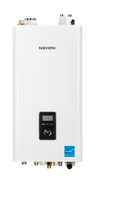
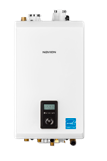
These Navien models are combi-boilers, not standalone tank water heaters. The supplied brochure describes compact, wall-mounted NCB-H and NFC-H families with stainless steel heat exchangers; it identifies NFC-H as the higher heating-output family. Optional remote-control accessories are described separately.
View brochure ↗Navien NCB-HSpace heating + domestic hot waterView brochure ↗Navien NFC-HSpace heating + domestic hot water
Source: Navien brochure, June 2023. Confirm current models, accessories and warranty terms. Hot-water capacity depends on incoming water temperature and simultaneous demand.
Heating-only or a combined heating-and-hot-water solution.
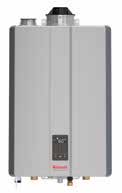
Boilers heat water that circulates through compatible radiators, baseboard or radiant systems. Rinnai’s supplied I-Series brochure covers both heating-only and combi models. It describes condensing operation, compact dimensions and outdoor-reset control, which adjusts heating operation in response to outdoor conditions.
View brochure ↗Rinnai I-SeriesHeating-only and combi versions in the series
What we consider
Your building’s heating demand and existing emitters.
Whether you need space heating only or domestic hot water too.
Available space, fuel, venting and system requirements.
The brochure describes proportional control on combi models to support both central heating and domestic hot water. Features depend on the specific model.
Source: Rinnai I-Series brochure, November 2019. This reference does not establish current availability or warranty coverage. Photos identify product families, not a selected capacity for your property.
Furnaces warm air for distribution through ducts. Boilers circulate heated water through compatible emitters. Heat pumps move heat into the building. We consider your existing system, building layout and heating needs before recommending a direction.
01Heat source→
02Distribution system→
03Comfortable rooms
Heating overview — the distribution method depends on the system.
A central air-conditioning system removes heat from indoor air and releases it outdoors. Duct condition, airflow, sizing and controls all affect room-to-room comfort. We can discuss replacement equipment or a complete system design.
01Indoor air gives up heat→
02Refrigerant moves heat→
03Heat released outdoors
Simplified cooling cycle; refrigerant circulates in a closed loop.
Heat pumps move heat rather than relying only on generating it. A system can deliver heat indoors in heating mode and move it outdoors in cooling mode. In Southern New Hampshire, model selection should account for winter conditions, the building’s heat loss and any backup heating plan.
01Outdoor heat→
02Heat pump in heating mode→
03Heat delivered indoors
Heat direction shown for heating mode; cooling reverses the transfer.
Ductless systems connect an outdoor unit to one or more indoor units. They can be considered for additions, rooms without ducts or comfort zones. Indoor-unit placement and equipment matching matter; a multi-zone system still has a shared overall capacity.
01Outdoor unit→
02Refrigerant connections→
03One or more indoor zones
Simplified system arrangement, not an installation drawing.
Air balancing evaluates how conditioned air is distributed. Ventilation brings outdoor air into a building through an appropriate system. These are different tasks: adjusting room airflow does not automatically provide fresh air. We assess the building’s comfort and airflow concerns before recommending changes.
01Measure room airflow→
02Assess distribution→
03Adjust and verify
Air-balancing assessment. Ventilation needs are evaluated separately.
A higher equipment rating is only part of the picture. Appropriate sizing, distribution, controls and maintenance also influence performance. Condensing boilers recover additional heat from combustion exhaust; the system must be designed to support their intended operation.
01Building needs→
02Right-sized equipment→
03Controls & maintenance
A whole-system approach to comfort and efficiency.
ecobee’s thermostat range includes Essential, Enhanced and Premium. Connected app control and scheduling help you manage comfort; sensors and other features vary by model. Compatible room sensors can help account for temperatures beyond the thermostat’s location.
01Your schedule & room readings→
02Compatible thermostat→
03Heating or cooling call
Simplified thermostat control diagram, not a wiring guide. Connected app functions require network and account setup.
Before selecting a thermostat, we review the equipment, wiring and existing controls. A thermostat is not universally compatible with every boiler, heat pump or mini-split, and a smart control alone cannot resolve every airflow or sizing issue.
Manufacturer names are provided for education. Listing does not imply authorized-dealer status, affiliation or endorsement. Equipment availability, suitability and warranty terms must be confirmed for each project.

 View brochure ↗
 View brochure ↗